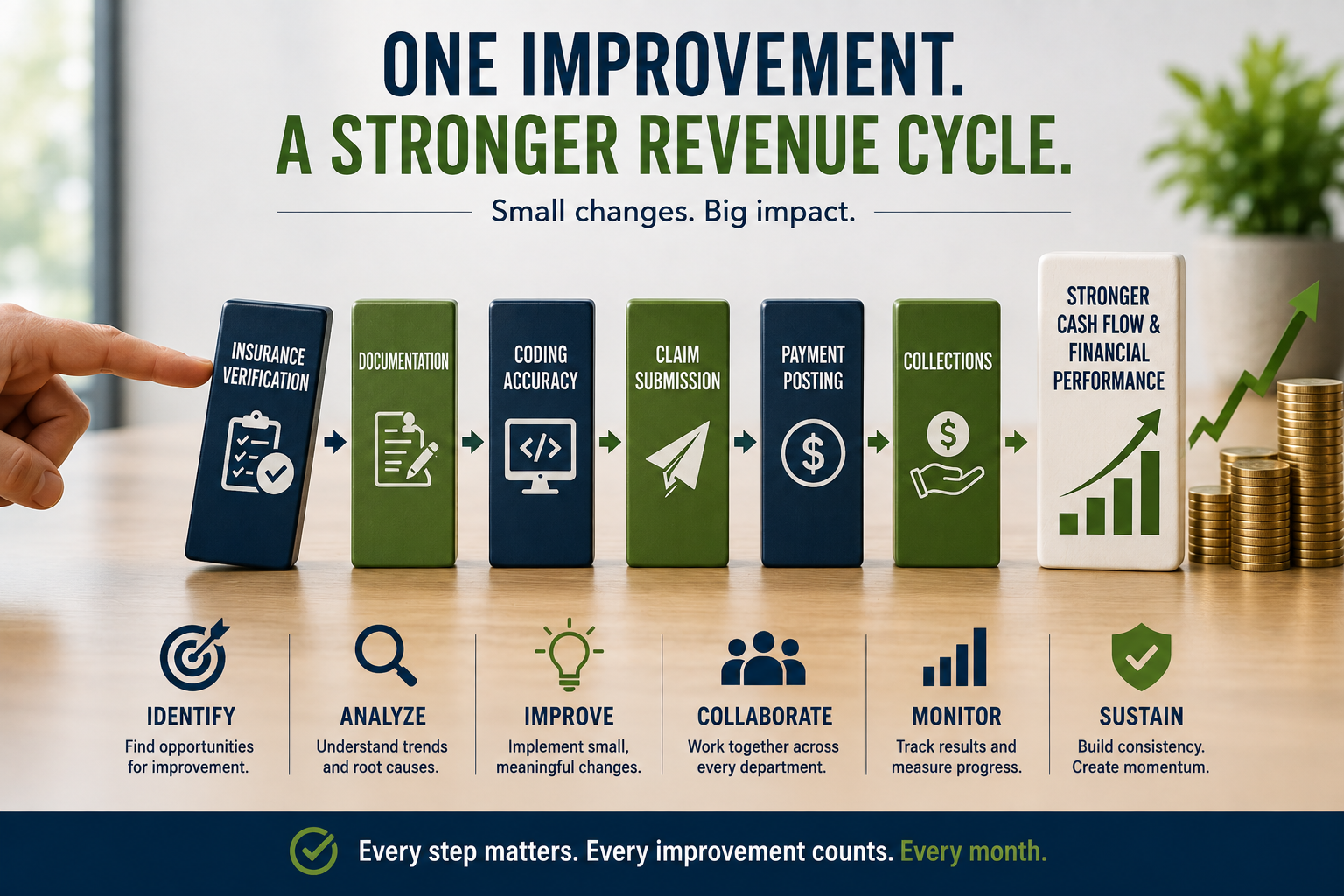
Every healthcare organization wants a high-performing revenue cycle.
Fewer denials. Faster payments. Better cash flow. Stronger financial performance.
Yet these results rarely happen by chance.
They are the product of hundreds of small decisions made consistently over time. The highest-performing organizations don't necessarily have larger staffs or more sophisticated technology. They have better processes, clearer accountability, and a commitment to continuous improvement.
Small Changes Create Big Results
Many leaders assume improving the revenue cycle requires a major overhaul.
In reality, meaningful improvements often begin with small, deliberate changes.
Consider these examples:
Example 1: Better Insurance Verification
An organization notices an increase in claim denials caused by incorrect insurance information.
Instead of asking the billing department to work more denials, leadership updates the registration checklist, provides additional staff training, and verifies insurance before each visit.
The result?
- Fewer rejected claims
- Less rework for billing staff
- Faster reimbursement
- A better patient experience
The process changed—not the people.
Insert CTA & Link to front Desk Training
Example 2: Stronger Provider Documentation
Providers receive occasional coding queries because documentation is incomplete.
Rather than accepting the delays, leadership reviews the most common documentation gaps with providers and develops simple documentation reminders.
Over the next several months:
- Coding questions decrease.
- Claims are submitted more quickly.
- Documentation becomes more consistent.
- Compliance risk is reduced.
A small educational effort creates improvements throughout the revenue cycle.
Example 3: Reviewing Denial Trends
Instead of treating every denial as an isolated event, leadership begins reviewing denial trends during a monthly meeting.
They discover one payer has consistently denied claims for the same authorization issue. The practice updates its workflow. The recurring denials largely disappear.
The lesson?
Sometimes the solution isn't working harder—it's recognizing the pattern.
Example 4: Defining Accountability
Leadership notices that recurring problems often bounce from one department to another.
No one is certain who owns the issue.
The practice clearly defines responsibilities for scheduling, registration, insurance verification, providers, coding, billing, credentialing, and leadership.
Now, when an issue arises, the appropriate team investigates the root cause and works collaboratively to resolve it.
Problems are addressed more quickly because everyone understands their role.
High-Performing Practices Never Stop Improving
One of the biggest differences between average and exceptional organizations isn't perfection.
It's consistency.
High-performing practices regularly ask:
- What's working well?
- What's slowing us down?
- What trends are we seeing?
- What can we improve this month?
They're always looking for opportunities to strengthen the revenue cycle, even when financial performance appears strong.
Progress Beats Perfection
No healthcare organization has a flawless revenue cycle.
Payers change policies. Regulations evolve. Staff members come and go. New challenges emerge every year.
The organizations that consistently perform well aren't the ones that avoid every problem—they're the ones that identify issues early, learn from them, and continuously improve their processes.
Over time, those small improvements add up to stronger financial performance, greater operational efficiency, and a healthier organization.
That's why high-performing revenue cycles don't happen by accident.
They're built intentionally, one improvement at a time.
Frequently Asked Questions
What makes a revenue cycle high-performing?
Do practices need to make major changes to improve their revenue cycle?
How often should healthcare organizations evaluate their revenue cycle?
Why is continuous improvement important?
Every Improvement Starts with Understanding Where to Improve
The strongest revenue cycles aren't built overnight—they're built through continuous evaluations and audits, clear accountability, and intentional process improvements.
At Applied Medical Systems, we help healthcare organizations identify opportunities to strengthen every stage of the revenue cycle through medical billing, coding, credentialing, practice administration, and revenue cycle assessments. Sometimes a few well-targeted improvements are all it takes to create lasting results.
If your organization is unsure where to start, an end-to-end revenue cycle evaluation or targeted audit can quickly highlight gaps, inefficiencies, and missed revenue opportunities. AMS can help you assess your current performance and build a clear roadmap for improvement.