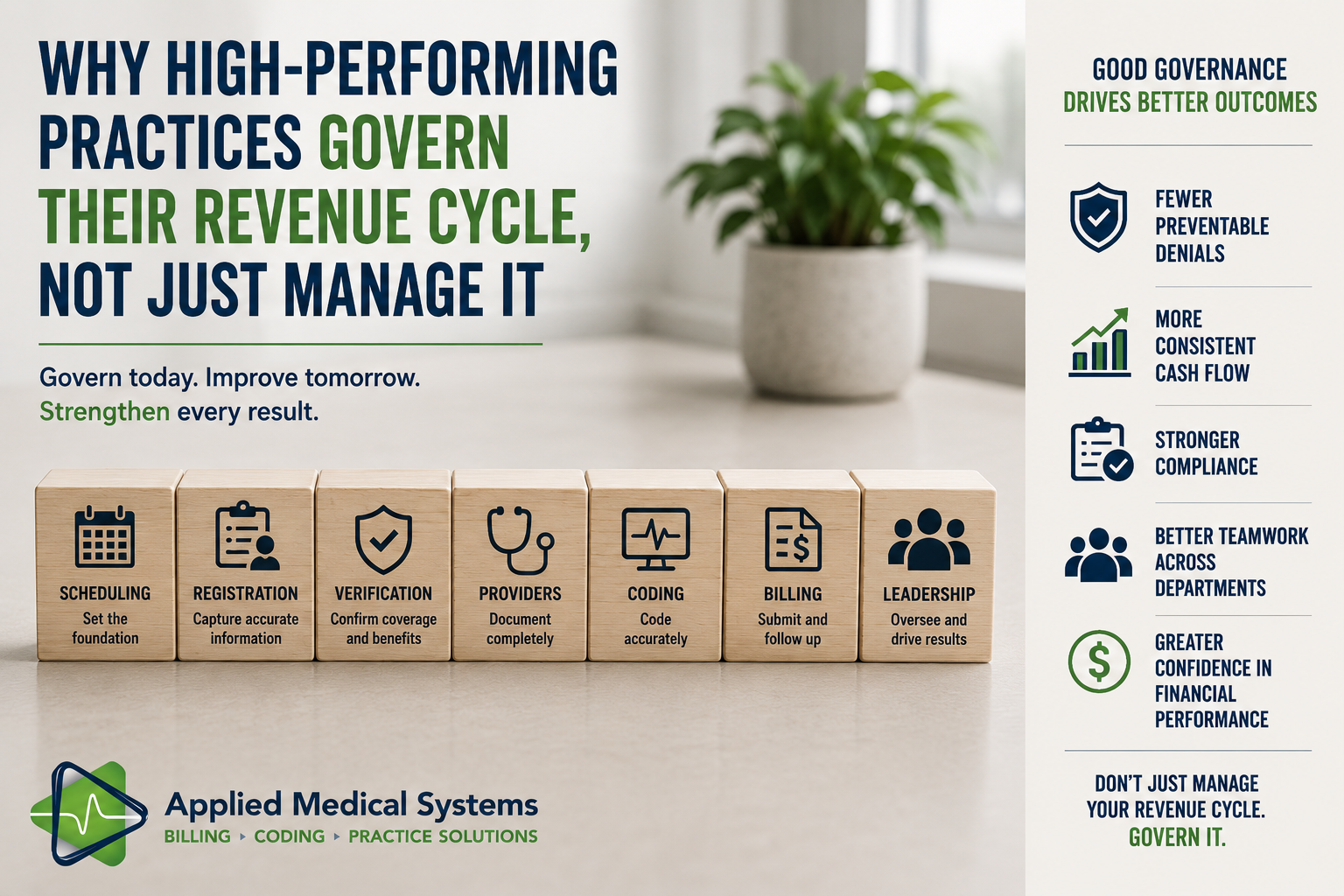
Most healthcare organizations manage their revenue cycle.
The highest-performing organizations govern it.
At first glance, those words may sound interchangeable, but they represent two very different approaches.
Managing the revenue cycle focuses on the day-to-day work: scheduling patients, verifying insurance, coding encounters, submitting claims, and following up on denials.
Governance focuses on something bigger:
Making sure those processes consistently work together to support the organization's financial health.
Management Keeps the Work Moving. Governance Keeps It Improving.
Think of it this way.
A practice may have an excellent billing team that works hard to appeal denied claims.
That's good management.
But leadership should also be asking:
- Why are these claims being denied?
- Are the same issues happening every month?
- Which department owns the problem?
- What changes will prevent these denials from happening again?
That's governance.
Instead of reacting to problems, governance looks for patterns, identifies root causes, and improves the process.
A Simple Example
Imagine a practice notices an increase in claim denials for missing prior authorizations.
A management approach might look like this:
- Billing staff rework the denied claims.
- Appeals are submitted.
- Payments are eventually collected.
The immediate problem gets resolved.
A governance approach goes further.
Leadership asks:
- Why were prior authorizations missed?
- Has the authorization process changed?
- Is staff training needed?
- Are responsibilities clearly defined?
- Is there a way to catch missing authorizations before the patient is seen?
Instead of fixing the same problem over and over, governance focuses on preventing it from happening again.
Governance Connects Every Department
The revenue cycle is often viewed as the responsibility of the billing department.
In reality, financial performance depends on nearly every department in the practice.
For example:
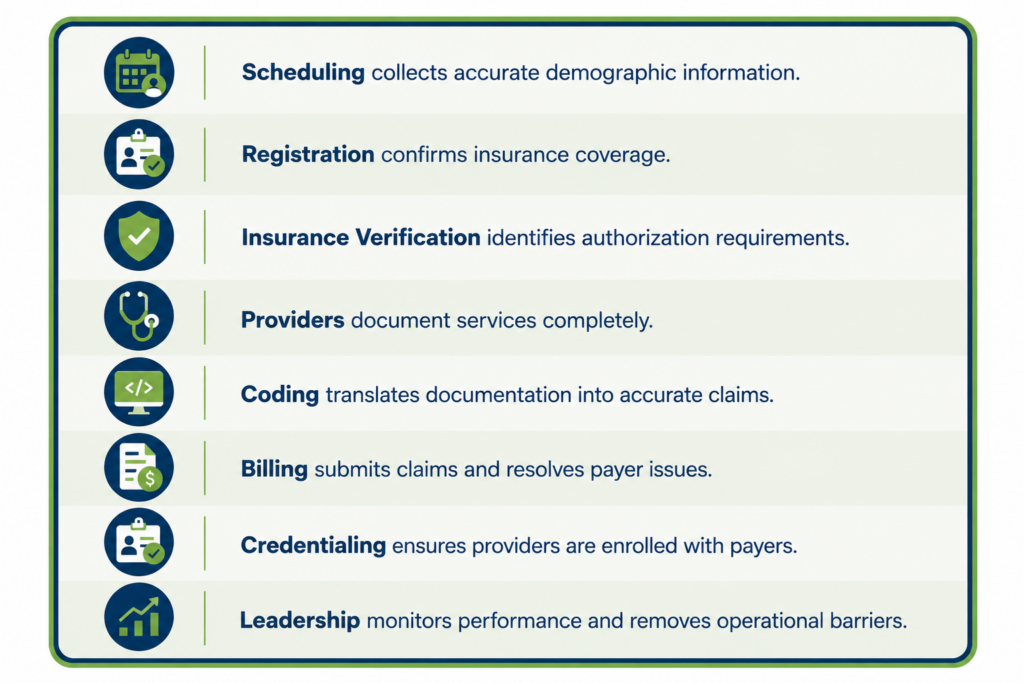
When these teams work independently, problems can go unnoticed until revenue is affected.
Governance brings everyone together around a common goal: protecting the organization's financial performance.
What Does Revenue Cycle Governance Look Like?
You don't need a large health system or a dedicated governance committee to govern your revenue cycle.
It can start with a few simple leadership habits:
- Reviewing revenue cycle performance every month—not just financial statements.
- Looking for trends instead of isolated problems.
- Assigning clear ownership when issues arise.
- Encouraging communication between departments.
- Tracking whether process improvements actually work.
- Conducting periodic internal or external revenue cycle audits.
These small steps create accountability and help prevent recurring problems.
Better Decisions Start With Better Visibility
One of the biggest benefits of governance is visibility.
Instead of learning about problems after revenue has been lost, leaders gain insight into where operational issues are developing and can address them early.
That means:
- Fewer preventable denials
- More consistent cash flow
- Stronger compliance
- Better teamwork across departments
- Greater confidence in financial performance
Management Is Essential. Governance Makes It Sustainable.
Every healthcare organization needs strong day-to-day operations.
But organizations that consistently perform well don't stop there.
They create clear accountability, monitor trends, evaluate risks, and continuously improve the processes that support reimbursement.
That's the difference between simply managing the revenue cycle and governing it.
Frequently Asked Questions
What is revenue cycle governance?
How is governance different from revenue cycle management?
Why is revenue cycle governance important?
Does a small medical practice need revenue cycle governance?
Strengthen Your Revenue Cycle with Confidence
Managing the revenue cycle keeps your practice running. Governing it helps your practice thrive.
Applied Medical Systems partners with healthcare organizations to improve billing, coding, credentialing, practice administration, and revenue cycle performance through independent assessments and operational expertise. If you're ready to move beyond simply managing your revenue cycle, we're here to help.