
Many healthcare organizations believe the billing department owns the revenue cycle.
It's an understandable assumption. After all, the billing team submits claims, follows up on unpaid balances, and works denials. But by the time a claim reaches the billing office, many of the factors that determine whether it gets paid have already been set in motion.
The truth is that the revenue cycle belongs to everyone.
Every interaction—from scheduling the appointment to posting the final payment—has the potential to improve or disrupt your organization's financial performance.
Revenue Starts Long Before a Claim Is Submitted
A healthy revenue cycle begins well before a patient is seen.
Consider just a few examples:
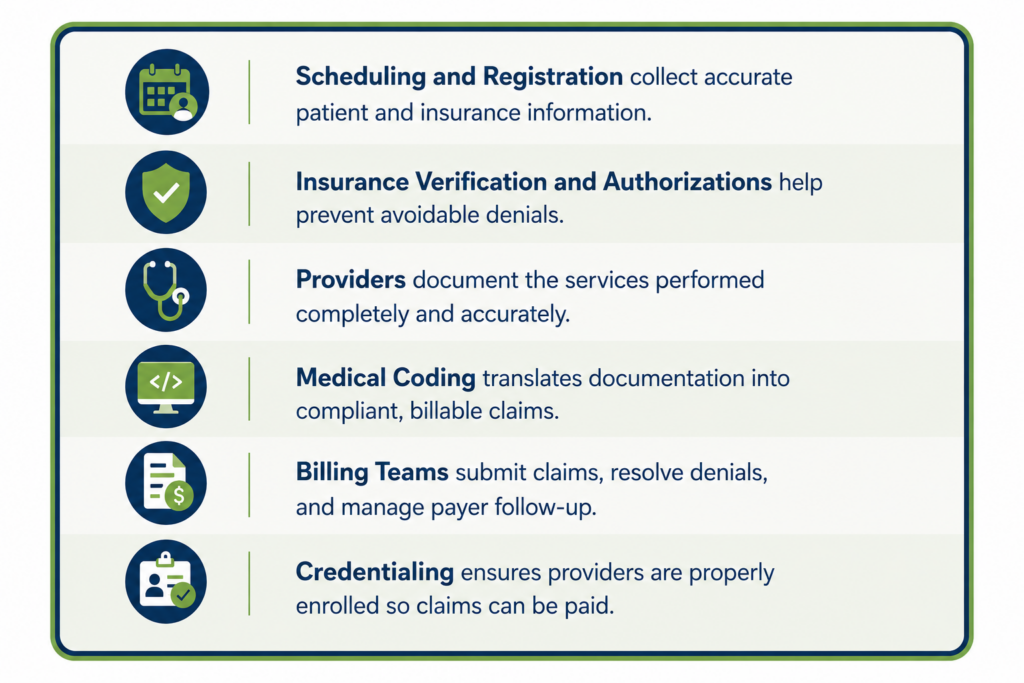
If any one of these steps breaks down, the impact is felt throughout the entire revenue cycle.
The Cost of "Someone Else's Problem"
One of the biggest challenges healthcare organizations face is fragmented accountability.
The front office may assume billing will catch errors.
Billing may believe documentation is the issue.
Providers may not realize how incomplete documentation affects reimbursement.
Meanwhile, leadership sees increasing denials, slower cash flow, and rising accounts receivable without recognizing where the problem actually began.
When every department focuses only on its own tasks, no one is truly managing the health of the revenue cycle.
Leadership Sets the Standard
Strong organizations don't assign revenue cycle responsibility to one department, they create shared accountability across the organization.
Leaders establish clear expectations, monitor key performance indicators, encourage communication between departments, and address issues before they become costly problems.
When everyone understands how their role impacts reimbursement, the entire organization benefits through:
- Fewer claim denials
- Faster reimbursement
- Improved compliance
- Better patient experiences
- Stronger financial performance
Governance Creates Better Results
High-performing healthcare organizations recognize that the revenue cycle isn't just a billing function, it's a business function.
Creating a culture of accountability across scheduling, registration, providers, coding, billing, credentialing, and leadership helps reduce risk and improve financial performance over time.
Because when everyone owns the revenue cycle, everyone contributes to its success.
Frequently Asked Questions
Who is responsible for the revenue cycle in a healthcare organization?
Why isn't the billing department solely responsible?
What is revenue cycle governance?
How can healthcare leaders improve revenue cycle performance?
Ready to Strengthen Your Revenue Cycle?
Contact Applied Medical Systems today to learn how our billing, coding, credentialing, practice administration, and revenue cycle audit services can help your organization build a stronger, more accountable revenue cycle.