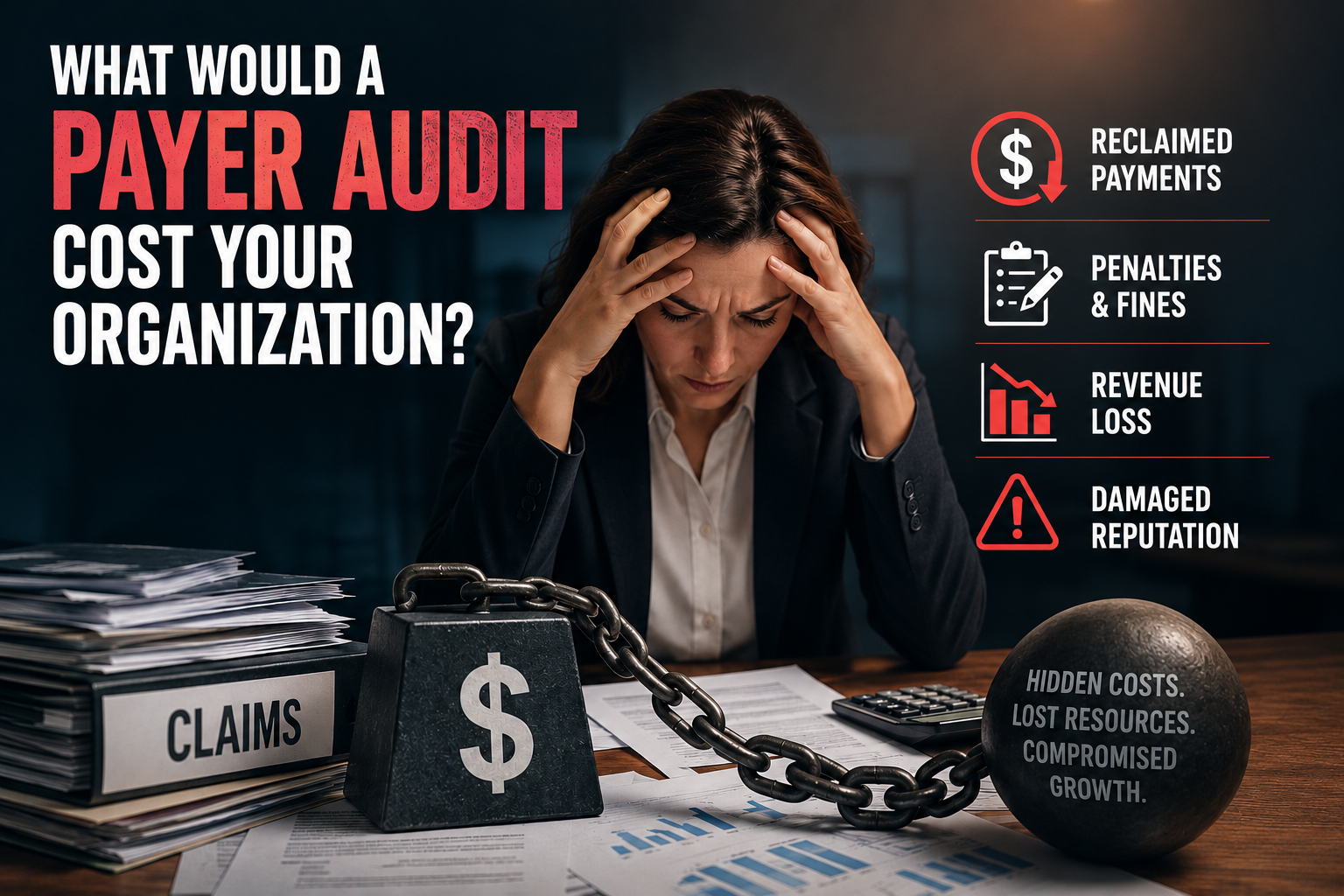
Most healthcare leaders think of payer audits in terms of recoupments, but the financial impact is often only a small part of the overall cost. This article explores the hidden operational, compliance, and productivity costs of a payer audit, and why a proactive revenue cycle audit can help organizations reduce risk before an external review occurs.
Most healthcare leaders understand that payer audits are part of doing business.
What many don't realize is that the greatest cost of an audit often isn't the audit itself.
It's everything that comes after.
By the time an external audit begins, your organization has already shifted from preventing problems to responding to them.
That response can consume far more time, money, and resources than most leaders anticipate.
The Cost Goes Far Beyond Recoupments
When healthcare leaders think about a payer audit, the first concern is often recoupments.
While repayment of previously reimbursed claims can certainly have a financial impact, it's only one part of the overall cost.
A payer audit can affect nearly every part of your organization, including:
- Hundreds of hours spent gathering records and supporting documentation
- Leadership time diverted away from strategic priorities
- Providers, billing teams, and administrative staff pulled away from daily operations
- Delayed payments while claims are under review
- Consulting or legal expenses, if outside assistance is needed
- Additional education, corrective action plans, or process changes
- Increased scrutiny on future claims
- Reduced productivity across multiple departments
These operational costs often exceed the financial impact of the audit findings themselves.
The true cost isn't just what you repay, it's the time, disruption, and organizational focus required to respond.
The Better Question Is: Are You Prepared?
Healthcare organizations operate in an increasingly complex reimbursement environment.
Data analytics have made it easier for payers to identify unusual billing patterns, documentation concerns, and coding trends.
Rather than asking whether an audit could happen, leadership should be asking:
"If it did happen tomorrow, how prepared would we be?"
Preparation doesn't eliminate the possibility of an audit.
It does reduce the likelihood that an audit uncovers problems your organization didn't know existed.
Preparation Costs Less Than Reaction
Most organizations don't schedule a revenue cycle audit because they believe something is wrong.
They do it because they want confidence.
A proactive audit allows leadership to:
- Validate documentation and coding practices
- Identify operational vulnerabilities
- Correct issues before they attract outside attention
- Strengthen consistency across providers and departments
- Reduce uncertainty about organizational performance
That's a far less expensive conversation than explaining findings after an external review has already begun.
Leadership Is About Managing Risk
Strong healthcare leaders don't wait for problems to become crises.
They invest in understanding where their organization is vulnerable while they still have time to make improvements.
A proactive audit isn't simply a compliance exercise.
It's a leadership tool.
It provides objective information that helps organizations protect revenue, strengthen operations, and make informed decisions before outside pressure forces action.
The Cost of Waiting
Throughout this series, we've explored hidden risks, operational blind spots, and audit readiness.
The common thread is simple:
The biggest risks are rarely the ones you already know about.
They're the ones you haven't uncovered yet.
The cost of an external payer audit isn't measured only by recoupments.
It's measured by disruption, uncertainty, lost productivity, and opportunities that were missed because problems weren't identified sooner.
Take Control Before Someone Else Does
The best time to evaluate your revenue cycle isn't after receiving an audit letter.
It's before anyone has a reason to send one.
At AMS, our independent revenue cycle audits help healthcare organizations identify documentation, coding, operational, and compliance risks before they become costly problems.
Our goal isn't simply to find issues.
It's to give leadership the clarity and confidence needed to move forward.
Ready to Reduce Risk Before It Becomes Costly?
If your organization has never completed an independent revenue cycle audit—or if it's been several years since your last comprehensive review—now is the time to evaluate where you stand.
👉 Schedule a Revenue Cycle Audit Consultation with AMS
A proactive audit is an investment in confidence. Waiting for an external audit is often far more expensive.
Frequently Asked Questions
What costs are associated with a payer audit?
Can a proactive revenue cycle audit reduce the impact of a payer audit?
How can healthcare organizations prepare for a payer audit?
What is the difference between a proactive audit and a payer audit?
Why should executive leadership care about revenue cycle audits?
How often should healthcare organizations perform revenue cycle audits?
How can AMS help organizations prepare for future payer audits?