
Who is responsible for running the business side of a medical practice?
Depending on the organization, the answer could be the practice manager, business manager, administrator, or another member of the leadership team. In some practices, one person handles responsibilities that would be divided among several positions in a larger organization.
That can make the difference between a practice manager and business manager difficult to define. The titles matter less than understanding who is responsible for the operational, financial, and administrative functions that keep the practice running.
What Does a Practice Manager Do?
A practice manager is typically closely involved in the day-to-day operation of a medical practice. The role can be broad, particularly in small and midsize organizations.
Responsibilities may include:
- Managing staff and staffing needs
- Overseeing scheduling and patient flow
- Managing office policies and procedures
- Monitoring operational performance
- Coordinating vendors and technology
- Supporting regulatory and compliance requirements
- Overseeing or monitoring revenue cycle performance
- Participating in budgeting and financial management
- Addressing patient and staff concerns
- Reporting operational and financial information to practice leadership
The scope depends heavily on the size and structure of the organization. A practice manager in a three-provider office may handle responsibilities that would be divided among an operations manager, HR manager, revenue cycle manager, and finance team in a much larger medical group.
This is why defining the position as primarily a clinical role can be misleading. Today's practice manager may be responsible for decisions that affect nearly every part of the business.
What Does a Business Manager Do in a Medical Practice?
When a medical practice has a separate business manager, the position may have greater responsibility for the financial and administrative side of the organization.
Responsibilities may include:
- Budgeting and financial reporting
- Revenue cycle oversight
- Accounts payable and bookkeeping
- Contract and vendor management
- Human resources and employee benefits
- Business planning
- Payer and insurance matters
- Monitoring expenses and financial performance
- Supporting growth or expansion decisions
The exact responsibilities vary considerably.
In one organization, the business manager may oversee billing and collections. In another, those responsibilities may belong to the practice manager or a dedicated revenue cycle team. Larger organizations may have a CFO, administrator, HR department, revenue cycle director, and other leaders handling functions that one business manager oversees in a smaller practice.
Practice Manager vs. Business Manager: Where Do the Roles Overlap?
There is no universal line separating the two positions.
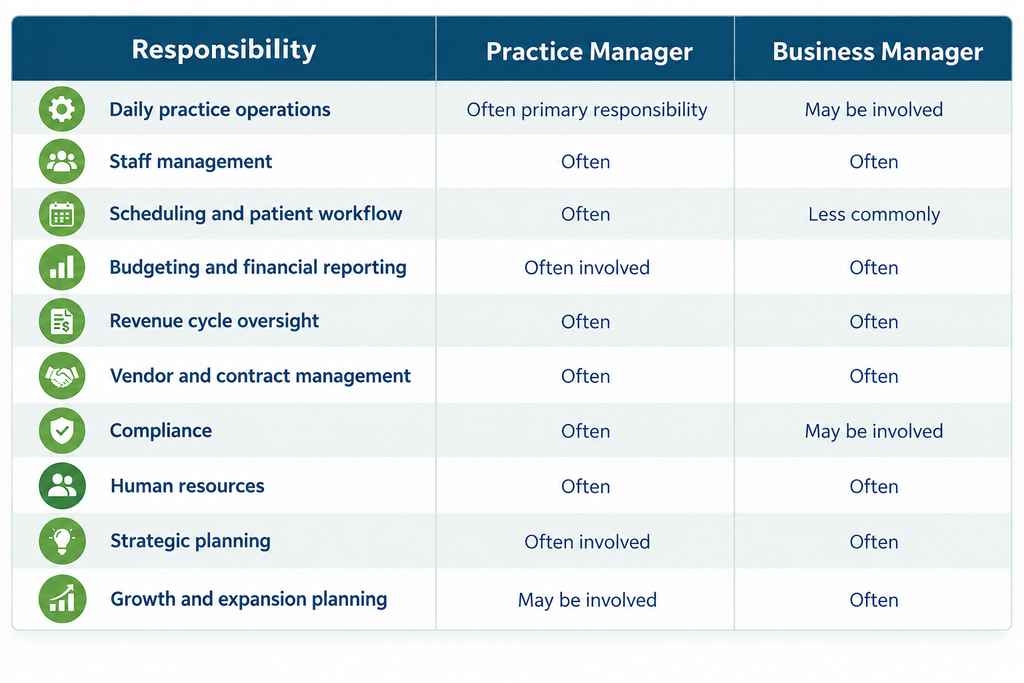
The division of responsibility should reflect the needs and structure of the practice rather than the job title alone.
For leadership, the more important question is whether each responsibility has a clear owner.
When One Manager Is Wearing Too Many Hats
Combining responsibilities can work well, especially in a smaller practice. Problems can develop as the organization grows and the responsibilities continue to accumulate.
A practice manager may spend the morning addressing staffing issues and scheduling problems, then move to a vendor meeting, a patient complaint, credentialing paperwork, and a technology issue.
At the same time, leadership may expect that manager to monitor accounts receivable, understand denial trends, evaluate payer performance, oversee billing, review financial reports, maintain compliance, and identify operational problems before they affect revenue.
There is a limit to how much one person can effectively monitor.
When managers spend most of their time responding to immediate operational needs, longer-term issues can receive less attention.
Revenue Cycle Oversight Is a Good Example
Revenue cycle management illustrates how easily responsibilities can become unclear.
A billing team may handle claims, payment posting, denials, and follow-up. That does not necessarily answer who is accountable for overall revenue cycle performance.
Practice leadership should know:
- Who reviews aging A/R trends?
- Who monitors denial patterns and identifies recurring causes?
- Who tracks payer performance?
- Who oversees credentialing and enrollment issues that affect payment?
- Who monitors adjustments and write-offs?
- Who determines whether billing processes are working as intended?
- Who reports meaningful revenue cycle information to ownership?
If several people assume someone else is monitoring these areas, problems can continue longer than leadership realizes.
Clear accountability matters more than which job title appears on the organizational chart.
How Do You Know When Your Management Structure Needs Additional Support?
Hiring another manager is not necessarily the first or only solution. The first step is identifying where responsibilities are becoming difficult to manage.
Leadership can start by asking:
Are important reports being reviewed consistently?
Producing reports has limited value if no one is responsible for interpreting the information and acting on it.
Are the same operational problems recurring?
Repeated billing issues, credentialing delays, staffing problems, or workflow breakdowns can indicate that managers have enough time to respond to problems but insufficient time to address their causes.
Does leadership know who owns each major function?
Billing, credentialing, compliance, HR, payer relations, financial reporting, and practice operations should have clearly defined accountability.
Is the practice dependent on one person knowing how everything works?
Heavy dependence on one manager can create operational risk when that person is unavailable or leaves the organization.
Has the practice grown without changing its management structure?
Adding providers, locations, employees, service lines, or payer relationships increases administrative complexity. A management structure that worked well several years ago may need to evolve with the practice.
Adding Expertise Without Adding Another Full-Time Management Position
Practices do not have to perform every administrative function internally.
Some organizations choose to keep overall management and decision-making in-house while using outside expertise for specialized functions such as medical billing, revenue cycle management, credentialing, compliance, contracting, or practice administration. This can allow the practice manager or administrator to maintain oversight while reducing the amount of specialized work competing for their attention.
The right structure depends on the practice. What matters is that leadership understands who is responsible for each function, has access to the information needed to evaluate performance, and can identify when internal resources are stretched too thin.
Where Applied Medical Systems Can Help
Applied Medical Systems works with medical practices that need additional support across revenue cycle and practice administration. Our services include medical billing, coding, revenue cycle management, credentialing and enrollment, auditing, compliance support, and practice administration services.
The goal is to give practice leadership greater visibility and support in areas that can be difficult to manage alongside daily operations.
If your management team is spending more time responding to administrative problems than evaluating practice performance, it may be worth examining where responsibilities are concentrated and where additional expertise could help.
Talk with Applied Medical Systems about your practice's revenue cycle and administrative needs.
Frequently Asked Questions
Is a practice manager the same as an office manager?
Does a practice manager handle billing?
What does a business manager do in a medical practice?
Does a medical practice need both a practice manager and a business manager?
When should a medical practice consider additional management support?