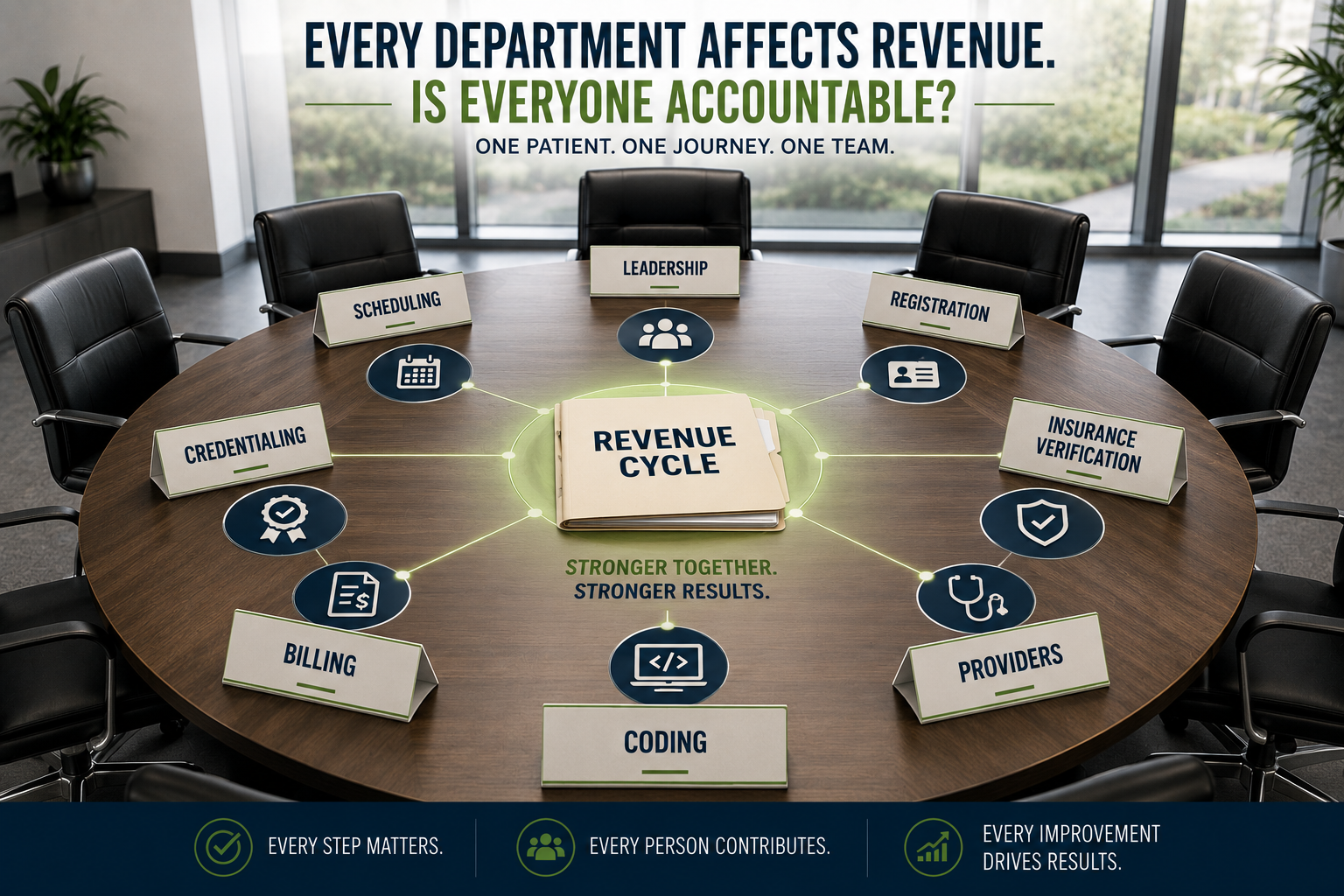
When a healthcare organization experiences declining collections or increasing claim denials, the billing department often receives the first phone call.
But is the billing team really where the problem started?
In many cases, the answer is no.
The revenue cycle doesn't begin when a claim is submitted. It begins the moment a patient schedules an appointment. Every department that touches the patient experience also influences whether your organization gets paid accurately and on time.
The question isn't whether each department affects revenue.
The question is whether everyone is accountable for it.
Revenue Is a Team Effort
Think about the patient journey.
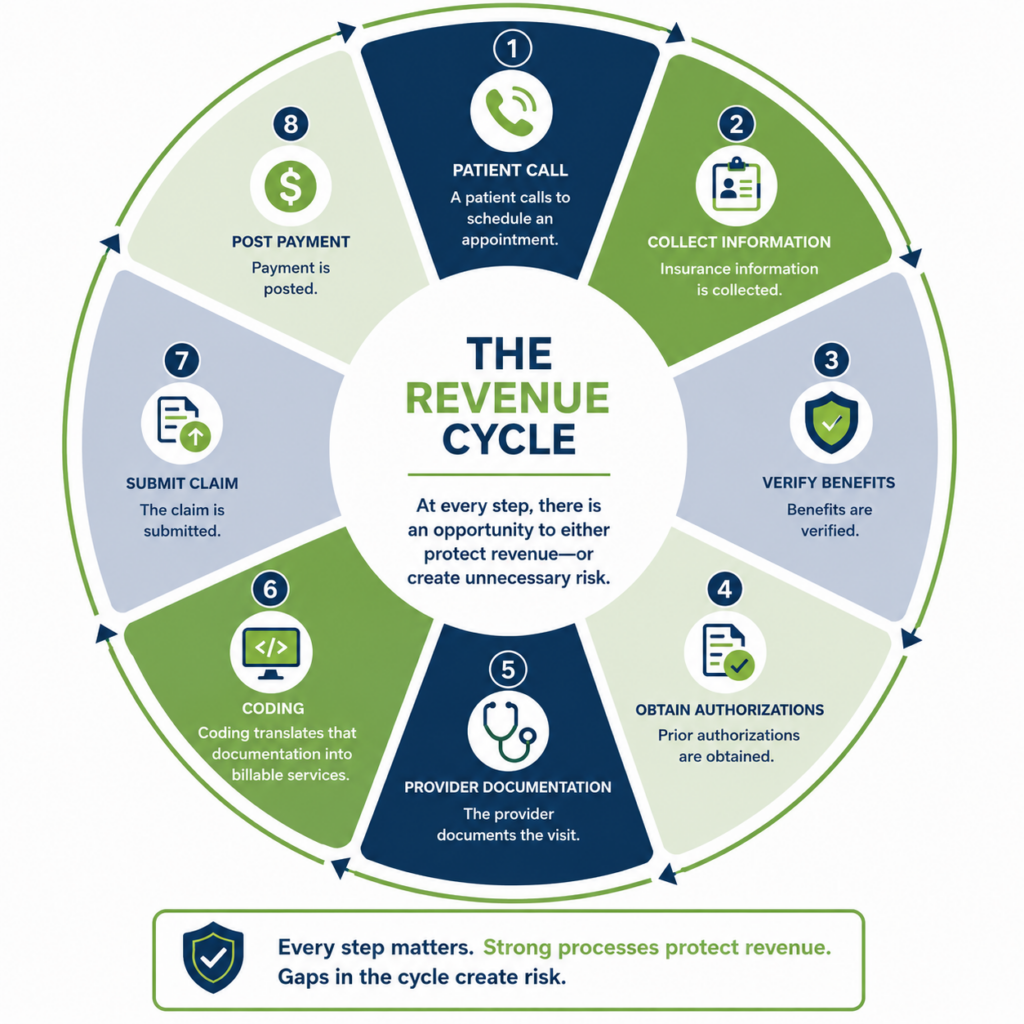
A patient calls to schedule an appointment.
Insurance information is collected.
Benefits are verified.
Prior authorizations are obtained.
The provider documents the visit.
Coding translates that documentation into billable services.
The claim is submitted.
Payment is posted.
At every step, there is an opportunity to either protect revenue or create unnecessary risk.
Small Mistakes Have Big Consequences
Consider these common examples.
- A scheduler enters the wrong insurance information.
- The claim is submitted to the wrong payer and payment is delayed.
- Registration forgets to update a patient's new insurance card.
- The claim is rejected before it can even be processed.
- Prior authorization isn't obtained.
- The payer denies the procedure.
- A provider's documentation doesn't fully support the services performed.
- Coding must request clarification, delaying claim submission.
- A provider's credentialing expires.
- Claims are denied because the provider is no longer enrolled with the payer.
None of these problems originated in the billing department, yet every one affects reimbursement.
Accountability Looks Different Than Responsibility
Every department has responsibilities.
Accountability is different.
Responsibility means completing assigned tasks.
Accountability means understanding how those tasks impact the organization's financial performance.
For example:
- Scheduling is accountable for collecting accurate patient information.
- Registration is accountable for verifying insurance details.
- Insurance Verification is accountable for identifying authorization requirements.
- Providers are accountable for complete and timely documentation.
- Coding is accountable for accurate, compliant code selection.
- Billing is accountable for timely claim submission and payer follow-up.
- Credentialing is accountable for maintaining payer enrollment.
- Leadership is accountable for ensuring every department works together effectively.
When everyone understands both their role and its financial impact, the entire revenue cycle becomes stronger.
Leadership Creates Accountability
Accountability doesn't happen by accident.
It starts with leadership.
High-performing organizations establish clear expectations, measure performance, encourage collaboration, and address recurring issues before they become significant financial problems.
Instead of asking:
"Why are our denials increasing?"
They ask:
"Where in our process is this problem beginning?"
That shift changes the conversation from blame to improvement.
Revenue Cycle Success Is Built Together
One department cannot create an exceptional revenue cycle on its own.
Strong financial performance is the result of dozens of small processes working together every day.
When scheduling, registration, providers, coding, billing, credentialing, and leadership all understand how their work affects reimbursement, the organization is better positioned to reduce denials, improve cash flow, strengthen compliance, and deliver a better patient experience.
Because when everyone is accountable, everyone contributes to protecting revenue.
Frequently Asked Questions
Why isn't the billing department solely responsible for revenue cycle performance?
Which departments have the biggest impact on the revenue cycle?
What does accountability look like in the revenue cycle?
How can healthcare organizations improve accountability?
Build Accountability Across Your Revenue Cycle
Revenue cycle performance depends on more than one department—it depends on how well every department works together.
Applied Medical Systems helps healthcare organizations strengthen billing, coding, credentialing, practice administration, and revenue cycle operations through independent assessments and practical recommendations. By identifying process gaps and improving accountability across the organization, we help practices build a stronger, more resilient revenue cycle.